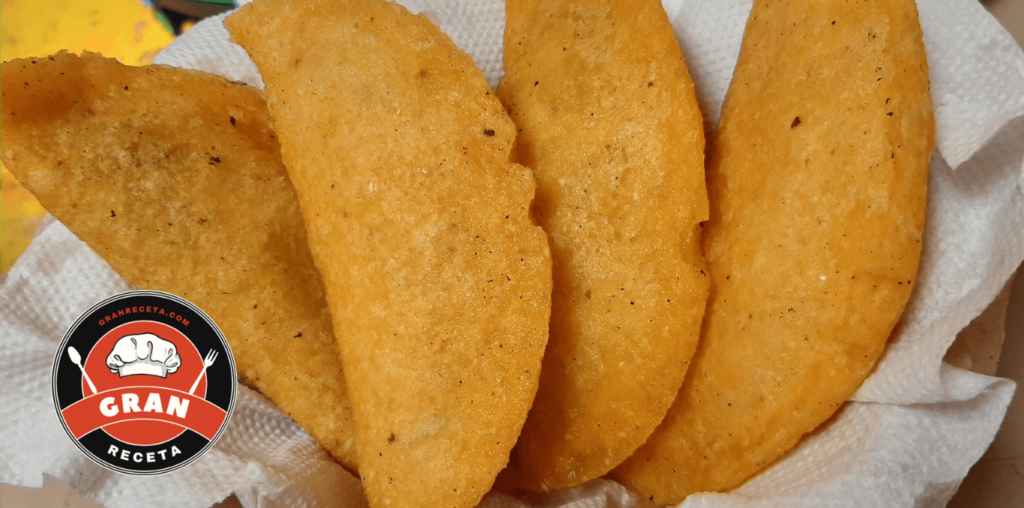
A Colombian empanada is a corn empanada: 80 g of yellow masarepa dough rolled to ⅛ inch, 45 g of shredded flank steak and yellow potato inside, and 3-4 minutes per side in 350°F oil until the shell shatters when you bite it. There’s no wheat, no butter and no oven; if you’ve only had Argentine or Spanish empanadas, this is a different food that happens to share the name. This is the Cali version, the empanada valluna, made 20 at a time, with US supermarket swaps for every ingredient, the timing of each stage, the two reasons they burst in the oil and how to freeze a batch unfried.
What a Colombian empanada is, and how the Cali one differs
How do you make Colombian empanadas? Pressure-cook flank steak 45 minutes and shred it; boil small yellow potatoes in that broth and crush them with a fork; mix beef and potato into a reduced guiso of tomato, scallion, cumin and annatto, and chill the filling 30 minutes. Make a dough from 4 cups of yellow precooked cornmeal and 4 cups of warm water, roll it to ⅛ inch, fill, seal with a smooth trimmed edge and fry at 350°F, 3-4 minutes per side. 150 minutes for 20 empanadas.
Every region of Colombia has its own empanada and nearly all of them are fried; what changes is the dough and the filling. The valluna or caleña (same thing: the Valle del Cauca department, or Cali its capital) is made of yellow precooked cornmeal with shredded beef and yellow potato, and in Cali it’s sold with a smooth, trimmed edge rather than a crimped one. Per the Spanish Wikipedia, the Antioquian one has a very thin corn shell with beef and potato, Popayán’s empanadas de pipián are filled with red potato and toasted peanuts, the coastal ones carry salty costeño cheese or ground beef, Santander’s are wheat dough with rice and minced meat, and Nariño’s use fermented “añejo” corn.
What they all share with this one, and what sets them apart from the Argentine baked empanada: corn, not wheat, and a fryer, not an oven.
The ingredients, and what to buy in a US supermarket
Everything here is in a big US supermarket or the Latin aisle. Two things can’t be swapped without changing the empanada: the cornmeal has to be precooked, and it should be yellow.
Yellow masarepa, 600 g (4 cups). P.A.N. amarilla or Goya yellow masarepa. Not masa harina (that’s nixtamalized, for tortillas) and not cornmeal or polenta (raw, won’t hold). White masarepa works with 2 teaspoons of annatto or turmeric for color; the ratio is 4 cups of liquid to 4 cups of flour, and the liquid is better warm and better still if it’s the beef broth.
Flank steak, 500 g (1.1 lb). A collagen-rich cut that shreds into long strands after 45 minutes under pressure. Skirt works; chuck roast works and is fattier. Sirloin or tenderloin won’t shred; they crumble into cubes.
Small yellow potatoes, 400 g (14 oz). Colombian papa criolla, or baby Yukon Gold, or frozen papas criollas from a Latin grocery. Boiled in the broth 8 minutes and crushed with a fork, they bind the beef into a filling that holds.
Annatto (achiote). The yellow-orange color in both the dough and the guiso. Turmeric plus a little paprika does the color; a Sazón packet does color plus salt, so cut the salt if you use one.
Ají. The fresh table sauce: tomato, onion, cilantro, lime and a hot pepper, finely chopped. Ten minutes, and the empanada isn’t complete without it.
How long they take
150 minutes, about 55 of them hands-on. The beef alone is 45 minutes under pressure, the filling needs 30 in the fridge, and 20 empanadas fry in four 7-minute batches. With the filling made a day ahead, frying day is 55 minutes: dough, shape, fry.
Three timings matter: 45 minutes under pressure so the flank shreds (2 hours in a pot), 30 minutes of chilling for the filling, and 3-4 minutes per side in the oil. Small yellow potatoes are done in the broth in 8 minutes; large Yukon Golds take 15.
What oil temperature, and why they burst
Corn dough fries at 350-360°F (175-180°C): cooler and the shell soaks up oil and comes out pale and greasy; hotter and the outside browns before the shell sets and cracks. Five at a time, so the temperature holds, and a minute between batches for the oil to climb back.
The bursting, though, almost never comes from the oil. It comes from the filling: if it’s warm or wet, it steams the moment it hits the fat, and steam pushes the shell open from inside. Reduce the guiso until no liquid remains, chill the filling 30 minutes, and press and trim the edge; a smooth trimmed edge seals better than a crimp.
How to make Colombian empanadas, step by step
The six timed steps are in the recipe card above. These are the two that decide whether they hold.
A dry, cold filling
Cook the guiso until a spoon leaves a furrow that doesn’t fill with liquid, fold in the shredded beef and crushed potato, and refrigerate 30 minutes. Made the day before, it’s better still. It’s the same shred-and-guiso logic as Colombian shredded beef, just drier.
⅛-inch dough and a trimmed edge
An 80 g ball flattened on greased plastic wrap with the bottom of a plate to a 5-inch disc, ⅛ inch thick; at ¼ inch the shell stays raw inside even when golden. Cold filling in the center, fold with the plastic, press the edge, and trim it with the rim of a cup. If the dough cracks when you fold, it needs water: a tablespoon, knead, try again.
Who this recipe is for
- If you have 1 hour → filling made the day before; today it’s dough, shaping and frying, 55 minutes.
- If it’s your first time → fry one test empanada before shaping the other 19: it tells you if the dough is hydrated right and the seal holds.
- If you have an air fryer → brush with oil and cook at 400°F (200°C) for 12 minutes, turning once. They crisp less and never burst; a fair trade on a weeknight.
- If you can’t find yellow masarepa → white masarepa with 2 tsp of turmeric in the dough.
- If you’re making 60 for a party → triple the filling and make it the day before; make the dough in 600 g batches so it doesn’t dry out while you shape.
Mistakes that ruin Colombian empanadas
They burst in the oil. Wet or warm filling, or an unsealed edge. Reduced, chilled filling and a pressed, trimmed edge.
Raw inside. Dough thicker than ⅛ inch, or oil too hot. ⅛ inch and 350°F.
Greasy and pale. Oil under 325°F or more than 5 in the pot. Let the oil recover between batches.
The dough cracks when folded. Too dry or unrested. A tablespoon of warm water, 2 minutes of kneading, 5 minutes under a cover.
The filling is dry and loose. Too little potato, or potato from a blender. Fork-crushed yellow potato is the binder.
They taste of cumin. One teaspoon for 20 empanadas is the ceiling.
Freezing, storing and reheating
Fried, they’re an eat-now food; they keep 2 days in the fridge and come back in a 400°F (200°C) oven for 8 minutes or an air fryer at 400°F for 5. The microwave softens them. The filling keeps 2 days refrigerated and freezes 3 months. Shaped, unfried empanadas freeze beautifully: 2 hours on a tray without touching, then bagged, up to 3 months, and fried straight from frozen at 340°F (170°C) for 5-6 minutes per side. On the table, the USDA FSIS rule for cooked food: 2 hours at most.
Variations
Chicken. Poached breast, 25 minutes, shredded in place of the 500 g of flank. Softer filling, and cheaper.
Pork. Shredded pork shoulder; juicier and fattier.
Vegetarian. 2 cups (400 g) of cooked lentils folded into the same guiso with the potato; the potato keeps the filling together.
Baked. 400°F (200°C) for 18-20 minutes, brushed with oil and annatto. Less crunch, and they never split.
What to serve with Colombian empanadas
With ají, always, and in Cali with a cold lulada or, at afternoon coffee, with hot chocolate. Two or three per person (about 550-800 kcal) make a snack; four with ají are a meal. For a Colombian fried spread, set them beside patacones with hogao and the fried Colombian egg arepa; for a Sunday brunch, before a plate of Colombian cheese arepas. The tamal valluno is the big Valle cousin built on the same yellow corn and guiso.
Frequently asked questions
Why do my empanadas burst when frying? Wet or warm filling, which steams inside the shell, or an edge that wasn’t sealed. Reduce the guiso until dry, chill the filling 30 minutes, and press and trim the edge.
What flour do you use for Colombian empanadas? Precooked cornmeal, masarepa, ideally yellow (P.A.N. amarilla, Goya). Not masa harina, not cornmeal, not wheat flour.
Can I freeze empanadas before frying? Yes. Freeze them shaped on a tray for 2 hours, bag them, and fry from frozen at 340°F for 5-6 minutes per side, up to 3 months later.
What’s the difference between Colombian and Argentine empanadas? Colombian empanadas are corn dough, fried, with a shredded beef and potato filling; Argentine ones are wheat dough, usually baked, with ground beef, egg and olives.
What cut of beef shreds best? Flank or skirt, cooked 45 minutes under pressure. Chuck roast also shreds and is fattier. Sirloin and tenderloin crumble.
How many calories in a Colombian empanada? About 275 kcal for a 4 oz (115 g) fried empanada, counting 10 g of absorbed oil, per the USDA-based calculation below.
Nutrition
Per empanada (125 g raw, about 115 g / 4 oz fried), calculated from the precooked cornmeal label (360 kcal per 100 g) and USDA FoodData Central (SR Legacy) for the lean flank, potato and guiso, counting 10 g of absorbed frying oil per piece, which is what mine weigh after frying compared with before:
- Calories: 275 kcal
- Protein: 8 g
- Carbohydrates: 28 g
- Fat: 15 g, of which 3 g saturated
- Fiber: 2 g
- Sugars: 1 g
- Sodium: 260 mg
For comparison, the USDA lists a Latino-restaurant beef empanada at 335 kcal per 100 g; this one comes out lighter per gram because the corn shell is thin and the flank is lean. Two with ají are a 550 kcal meal.
Venezuelan empanadas are corn too, but thicker, filled with ground beef, cheese or black beans, and never with potato. The first time I bit into a Cali empanada I was surprised twice, by the crunch and by the potato inside. Now, when I make the Venezuelan kind, I sometimes crush a yellow potato into the filling and don’t tell anyone. Josnaisis.