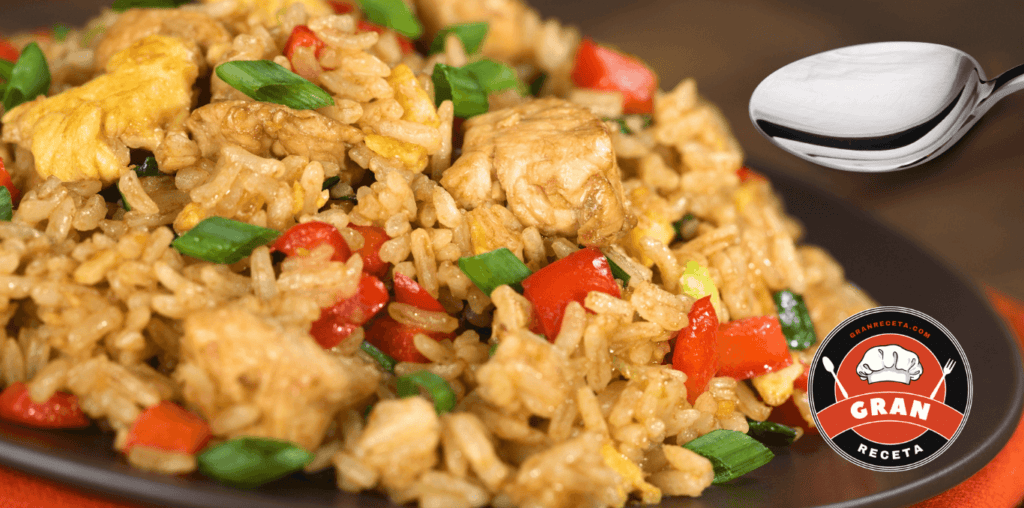
In Colombia, arroz con pollo means 600 g of chicken breast poached for 25 minutes, shredded, and folded through rice that was cooked in the very water the chicken came out of. Not yellow rice with chicken thighs on top. That second detail is the flavor. This is the home version, with cup and gram measurements, the supermarket swaps for the Colombian ingredients, a stage-by-stage timing chart and what it costs at US average prices.
What Colombian chicken rice is, and how it differs from other arroz con pollo
How do you make Colombian chicken rice? Poach chicken breasts in water with garlic and salt for 25 minutes and keep the stock. Cook long-grain rice in that stock, 2 cups of liquid per cup of rice, on a base of hogao, the Colombian tomato-and-onion sofrito colored with turmeric. Scatter the shredded chicken and vegetables on top, cover, and cook 15 minutes on the lowest heat. 75 minutes for 6 servings.
Arroz con pollo means “rice with chicken” and every Spanish-speaking country has its own. The Puerto Rican version cooks bone-in pieces with the rice and, as Elisabeth Lambert Ortiz notes in The Complete Book of Caribbean Cooking, is made with beer and annatto oil. The Peruvian one is green with cilantro. The Colombian version, the one I learned after moving from Venezuela, has three fixed features:
Shredded breast, not pieces. The chicken is poached separately, pulled into strands and mixed through the rice, so there is chicken in every forkful rather than a piece to cut around.
Hogao as the base. Hogao (oh-GOW) is the Colombian sofrito: tomato, scallion, onion, garlic, cumin and a yellow seasoning, cooked down until the tomato collapses. It is what makes the rice orange and gives it its depth.
The chicken’s own stock. The poaching water goes back into the pot as the rice’s liquid. A bouillon cube cannot replace it, and this is the step that makes the difference.
In Colombia it lands on the table with a handful of potato chips on top, sliced avocado and ketchup on the side. It sounds odd until you try it.
The ingredients, and what to use instead outside Latin America
Everything for this pot is in an ordinary US or UK supermarket. The Colombian names below are what you’ll see in Spanish-language recipes; the swaps are what I use when I cook it abroad.
Chicken breast, 600 g (1.3 lb). Breast shreds into long clean strands and gives a clear stock. Boneless thighs taste richer and shred shorter; poach them 20 minutes instead of 25 and skim the fat. Bone-in legs are the budget option (more below) and make the best stock of the three.
Long-grain white rice, 280 g (1½ cups). Jasmine works; basmati works. Short-grain and parboiled (converted) rice absorb differently, and the 2-to-1 ratio stops holding. If parboiled is all you have, use 3½ cups of stock.
Stock, exactly 720 ml (3 cups). The ratio is 2 cups of liquid to 1 cup of rice. If the poaching water doesn’t reach 3 cups, top up with hot water, never cold, which stalls the cooking.
The yellow. In Colombia the color comes from “color”, an annatto-based powder, or from Sazón packets. Half a teaspoon of turmeric gives the same color; a packet of Sazón Goya con Azafrán gives color, flavor and a lot of salt. If you use Sazón, halve the salt in the rice.
Ketchup, 3 tablespoons. It stands in for the sweet Colombian salsa de tomate that goes into the rice. It adds the sweetness and even color that fresh tomato alone doesn’t. It is not optional, and no one at the table will taste ketchup.
Peas, carrot, green beans. They go on top of the rice during the covered stage, never in with the stock, so they steam and keep their bite. Frozen goes in straight from the bag.
Salt, 1½ teaspoons total. Half in the poaching water, one in the rice. The nutrition numbers below assume exactly that.
How long it takes
75 minutes from a cold pot to the table, about 30 of them hands-on. The rest is chicken poaching by itself, rice cooking under a lid and 5 minutes of rest. Chop while the chicken poaches and make the hogao while the chicken cools, and it never stretches to an hour and a half.
Three timings matter. The breasts need 25 minutes covered at a bare simmer; boiled hard, the stock goes cloudy and the meat turns stringy. The rice needs 12 minutes uncovered to absorb the visible liquid, then 15 minutes covered on the lowest heat and 5 off the heat. If your pot has a thin base, slide a heat diffuser under it for that last stage; that’s where it scorches.
What it costs, and the cheaper cut
At the US city average retail prices the Bureau of Labor Statistics published for August 2026, boneless chicken breast was $4.173 per pound, so the 1.3 lb in this recipe cost $5.42. Bone-in chicken legs were $1.670 per pound: the same weight for $2.17. Rice was $1.111 per pound (0.62 lb here, $0.69) and field-grown tomatoes $1.977 per pound (0.55 lb, $1.09).
The chicken is the bill, and it is also the only line you can really change. Legs cost 40 % of what breast does per pound, the bones make a richer stock, and the meat shreds a little shorter, which nobody minds. Poach them 20 minutes, pull off the skin and bones, shred. The BLS doesn’t publish averages for peas, carrots, bell peppers or scallions, so those aren’t on the chart; between them they cost less than the tomatoes.
How to make Colombian chicken rice, step by step
The six timed steps are in the recipe card above. These are the two that decide the result.
The stock is the whole point
Cover the breasts with 4 cups of water, add garlic and salt, cover the pot and keep it at a bare simmer for 25 minutes. Then strain and measure 3 cups. With less, the rice comes out crunchy; with more, it turns to porridge. Poached breast leaves gelatin and dissolved protein in that water, and that is what a bouillon cube can’t give you. The same slow-poach-and-keep-the-broth logic is what makes a good Colombian sancocho, and it shows just as much in a pot of rice.
If you must use a cube or boxed stock, skip the teaspoon of salt in the rice; most boxed stocks already carry it.
The covered stage, and why the lid stays on
After 12 minutes uncovered, when the liquid has disappeared and the surface shows small craters, the chicken and vegetables go on top, the lid goes on, and it stays on for 15 minutes. Every time you lift it, the steam that is finishing the top layer escapes, and you get cooked rice at the bottom and chalky rice on top. The 5 minutes of rest with the heat off finish the job.
Who this recipe is for
- If you have an Instant Pot → poach the breasts on high pressure for 8 minutes with the same 4 cups of water, then a 10-minute natural release. Counting the time to come to pressure it isn’t faster than the stovetop, but it’s unattended and the stock is just as good. Cook the rice on the stove as written.
- If you have a rotisserie chicken → shred 2 cups (about 300 g) of meat and simmer the carcass in 4 cups of water for 20 minutes to make the stock. Better than a cube, not as clean as poached breast.
- If it’s your first time → the easiest mistake is eyeballing the stock. Use a measuring cup and write down how much the chicken gave you.
- If you’re cooking for 12 → double everything and use a wider pot, not a taller one; rice cooks evenly in a shallow layer. The rice timings don’t change; give the chicken 5 minutes more.
- If you’re gluten-free → the dish already is. Check the ketchup and any Sazón or bouillon label.
Mistakes that ruin the pot
Soggy rice. Almost always a hogao that wasn’t reduced. If the rice goes in while the tomato is still watery, it absorbs that liquid on top of the stock. Give the hogao its 8 minutes. If it’s already happened, uncover and cook 3-4 minutes over medium heat without stirring.
Crunchy rice, or raw on top. Not enough stock, or the lid came off. Add ½ cup of hot stock or water, cover, and give it 5 more minutes on the lowest heat.
Bland rice. It was cooked in water instead of stock, or all the salt went into the poaching water and none into the rice. The salt in the rice is the one you taste.
Dry chicken. It was shredded hot, or left uncovered. Cool it 10 minutes, shred it thick, and moisten it with 2 tablespoons of stock before it goes on the rice.
Mushy vegetables. They went in with the stock. They belong on top, in the covered stage.
Scorched bottom. Thin pot or too much heat during the covered stage. Use a diffuser and the true lowest setting on your burner.
Make ahead, storage and freezing
Rice and chicken both have clear safety rules, and cooked rice has one of its own. The numbers I follow are the USDA Food Safety and Inspection Service’s for leftovers.
Out of the fridge, 2 hours at most. Cooked rice is the classic food for Bacillus cereus: the spores survive cooking, and if the rice sits warm for hours they produce a toxin that reheating does not destroy. Spread leftovers in containers no more than 3 inches (7.5 cm) deep so they cool fast, and refrigerate.
In the fridge, 3 to 4 days at 40°F (4°C) or below, covered. It reheats better on day two than day three, so I aim for two.
In the freezer, 2 to 6 months for best quality. Freeze flat, single-portion packs, without the avocado or chips.
Reheating, to 165°F (74°C) in the center, covered, with 2-3 tablespoons of water or stock over low heat, or covered in the microwave with a stir halfway. Reheat once.
Make ahead. The hogao keeps 4 days in the fridge and freezes well, so on a weeknight the whole pot is 40 minutes: poach, make the rice on the ready hogao, cover.
Variations
With chorizo. In Colombia’s coffee region, 2 sliced chorizos go on top with the chicken for the covered stage. Spanish-style chorizo works; so does a smoked sausage.
With corn. A cup of corn kernels in with the peas. The most common home version.
With beer. Half a cup of lager in place of half a cup of stock. It is the Puerto Rican signature, and some Colombian cooks do it too. More than half a cup and the bitterness takes over.
Meatless. Vegetable stock at the same ratio and a drained 400 g (15 oz) can of chickpeas in the covered stage. Same technique, different flavor.
With bone-in legs. The budget version and, honestly, the tastiest: richer stock, 20 minutes of poaching, skin and bones off, shred.
What to serve with Colombian chicken rice
In Colombia it arrives with potato chips crumbled on top, sliced avocado and ketchup. For a fuller table, patacones with hogao, the twice-fried green plantains, use the same sofrito, and a batch of Colombian cheese arepas turns the 6 servings into a Sunday lunch. If you want the full spread of the region, this rice is the lighter cousin of the bandeja paisa. On the Caribbean coast the rice next to the fish is a different animal altogether, the golden Colombian coconut rice built on 40 minutes of caramelized coconut milk.
To drink, aguapanela with lime, cold, is what you’d get in a lunch spot in Bogotá. Leftover shredded chicken from the poaching turns into the filling of Colombian empanadas the next day.
Frequently asked questions
Is Colombian arroz con pollo the same as Spanish or Puerto Rican arroz con pollo? No. The Spanish and Puerto Rican versions cook bone-in chicken pieces with the rice, often with saffron or annatto and, in Puerto Rico, beer. The Colombian version poaches and shreds the chicken, cooks the rice in the poaching stock, and finishes with peas, carrots and green beans steamed on top.
Can I use rotisserie chicken? Yes. Shred about 2 cups (300 g) and simmer the carcass 20 minutes in 4 cups of water for the stock. You lose some cleanness of flavor but keep the technique.
What can I use instead of Sazón? Half a teaspoon of ground turmeric for the color, plus a quarter teaspoon of paprika if you want a hint of the annatto warmth. Sazón packets also carry salt, so if you use one, halve the salt in the rice.
Can I make it in a rice cooker? Make the hogao and poach the chicken on the stove. Put the rice, hogao and 3 cups of stock in the cooker, and when it switches to “keep warm”, add the chicken and vegetables, close the lid and wait 10 minutes.
Does it work with brown rice? It works, with 3¾ cups of stock and 35 minutes covered instead of 15. The texture is nuttier and the chicken goes in for the last 15 minutes only, so it doesn’t dry out.
How long does it keep? 3 to 4 days refrigerated at 40°F (4°C) or below, as long as it went into the fridge within 2 hours, per the USDA FSIS. Frozen, 2 to 6 months.
Nutrition
Per serving, about 310 g (11 oz), calculated ingredient by ingredient from the USDA FoodData Central database (SR Legacy) with the exact quantities above, including the 1½ teaspoons of salt:
- Calories: 390 kcal
- Protein: 28 g
- Carbohydrates: 50 g
- Fat: 8 g, of which 1 g saturated
- Fiber: 4 g
- Sugars: 7 g
- Sodium: 744 mg
Sodium is the number to watch: the salt in the pot accounts for 3,490 mg of the 4,460 mg total. With 1 teaspoon instead of 1½, a serving drops to roughly 550 mg. Each serving carries about 100 g (3.5 oz) of cooked chicken, which is more protein than most rice dishes of the region.
The first time I cooked this for my Colombian in-laws I poured the poaching water down the sink out of habit, the way we did in Venezuela, and my mother-in-law looked at me as if I’d thrown away the dinner. She was right. The stock is the dish. Josnaisis.