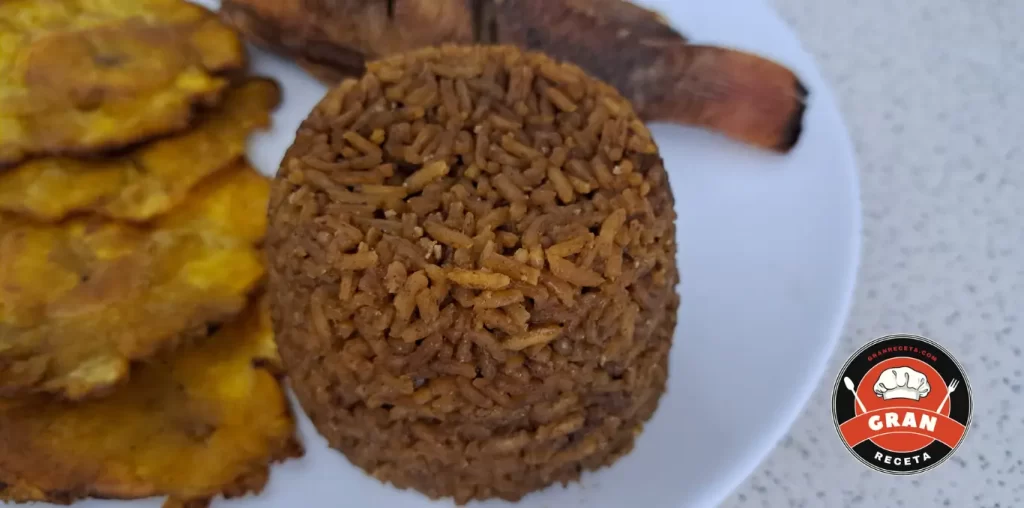
If you’ve had coconut rice in a Thai or Jamaican kitchen, Colombian coconut rice will surprise you: it’s brown, glossy and tastes toasted, sweet and salty at once. The reason is titoté. On Colombia’s Caribbean coast a can of coconut milk is boiled down, uncovered, for about 40 minutes until its 10 oz of water are gone and only 3 oz of coconut fat and some amber, caramelized solids remain. The raw rice is toasted in that fat before any water goes in, and that one step gives arroz con coco its color and its flavor. It takes 75 minutes for 6 servings of about 345 calories, and only 25 of those minutes need your hands.
How do you make Colombian coconut rice? Boil a can of full-fat coconut milk uncovered over medium-low heat for about 40 minutes, until the water evaporates and you’re left with oil and golden-brown solids, the titoté. Toast the raw rice in it for a couple of minutes, add water, panela, salt and raisins, boil uncovered until the surface water is gone, then cover on low for 18 minutes. About 75 minutes for 6 servings.
What titoté is, in one can of coconut milk
Coconut milk is an emulsion of fat and water. Per the USDA, canned coconut milk runs about 21 g of fat, 2.8 g of carbohydrate and 2 g of protein per 100 g; the remaining 73 % or so is water. Boil it uncovered and the water leaves, the emulsion breaks and the fat pools in the pot. Whatever isn’t fat, the coconut’s sugars and proteins, fries in that oil and browns. That’s titoté: coconut fat with caramelized solids, roughly 3.7 oz (105 g) from a 13.5-oz can.
Without it you have arroz con coco blanco, rice simmered in diluted coconut milk, white, mild and ready in 30 minutes. With it you have the Cartagena version served under whole fried fish, with patacones and salad. Per the Spanish Wikipedia, coastal cooks make it salted or sweetened with sugar or panela, some add cola and raisins, and it goes with patacones, posta (braised beef), fish and salad.
Which coconut milk works, reading the fat line
The failure I hear about most is the same one every time: 45 minutes of stirring and the milk never browns, it just turns into thick white paste. It’s almost always the can. Two things on the label matter:
The fat. Titoté is browned fat, so a can with little fat has little to brown. The Codex Alimentarius draws the lines: coconut cream starts at 20 % fat, coconut milk at 10 %, and anything sold as light can sit as low as 5 %. A full-fat can sits around 17-21 %, about 17 g of fat per ⅓-cup serving on a US label and roughly 3 oz (85 g) in the can. A light can has less than a quarter of that, and a quarter isn’t enough to coat 1½ cups of rice.
The stabilizers. Guar gum, xanthan gum and cellulose are in the can precisely to keep fat and water from separating on the shelf. They keep doing that job on your stove: the water boils off but the emulsion holds and the solids never brown. Look for cans whose ingredient list reads coconut and water, nothing else; a sulfite preservative is fine, it doesn’t affect the split. America’s Test Kitchen names Aroy-D as its pick for this reason, and the 2-ingredient Thai brands in the Asian aisle generally behave the same way.
The shopping list, and what to leave on the shelf
Everything besides the can is pantry. Long-grain white rice, 300 g (1½ cups), soaks up the oil without turning sticky; short-grain and Arborio have more starch and go gummy. Panela, 2 tbsp (28 g), is unrefined cane sugar sold in blocks; piloncillo in the Latin aisle is the same thing and dark brown sugar is a fair swap. Salt, 6 g (1 tsp). Dark raisins, 30 g (3 tbsp), optional but they’re the sweet-against-salty contrast the dish is known for. Cola, ½ cup (120 ml) in place of half the water, is a coastal habit for a darker color; diet cola has no sugar to caramelize and does nothing.
Slow titoté or fast titoté
The traditional way, and the one in this recipe, is medium-low heat with the lid off: about 40 minutes, little splatter, and enough slack to stir now and then while you cook the rest of dinner. America’s Test Kitchen speeds it up: medium-high heat with the lid ajar reduces the milk by three quarters in 10-12 minutes, then the solids brown in about 5 more. It works, and it saves 25 minutes, but those last 5 minutes go from amber to burnt without warning and you can’t leave the stove. If you’re in a hurry, that’s the shortcut; if you’re not, low heat forgives more.
How long it takes, 75 minutes
Think of it as a quarter hour of waiting, a half hour of stirring and a half hour of rice. For the first quarter hour the milk simply boils and stays white; an occasional stir is plenty. The half hour that follows is the titoté proper: the milk thickens, white clumps start floating in cloudy oil, and by the 45-minute mark they’ve browned to amber, sticking to the bottom within seconds if you stop moving the spoon. Once the rice is in, the last half hour is an ordinary pot of rice, uncovered until the surface water is gone and then covered on low, with nothing to watch.
With titoté made ahead, the whole dish drops to 35 minutes. I reduce 2 cans at a time and keep half in a jar in the fridge; it holds 2 weeks without trouble because it’s nearly all fat with no water left in it.
Step by step
The titoté, three stages you can see
Pour the can into a heavy 8-inch (20 cm) pot; a wider pot evaporates faster, a thin one scorches the bottom before the solids brown. Medium heat until it boils, then medium-low, always uncovered.
Stage 1, the first quarter hour. A rolling boil, still white. A stir a few times, scraping the bottom, is all it needs.
Stage 2, up to the half-hour mark. Half the volume is gone, the mixture thickens and white clumps float in oil that’s still cloudy. Stir about once a minute.
Stage 3, the last 10 minutes or so. The oil turns clear and the clumps go amber, the color of melted brown sugar. It smells like toasted coconut. Keep the spoon moving the whole time: this is where it burns.
With the titoté ready, add the 1½ cups of raw rice and stir 2 minutes until every grain shines. Add the 1½ cups of water, the panela, salt and raisins, raise the heat and boil uncovered about 8 minutes, until the surface water disappears. Lower to the minimum, cover, and don’t lift the lid for 18 minutes. Turn off, rest 5 minutes, fluff.
Fitting it to your kitchen
- If you’re in a hurry → jarred or day-ahead titoté, and the dish drops to 35 minutes; or the medium-high shortcut above, 50 minutes
- If it’s your first time → heavy or nonstick pot, medium-low heat, and a timer at 30 minutes so stage 3 doesn’t catch you away from the stove
- If you want the Cartagena color → swap half the water for cola, ¾ cup (180 ml) each; darker rice, caramel notes in the sweetness
- If you can’t find panela → 2 tbsp dark brown sugar; white sugar gives less color
- If you’re cooking for 12 → double everything and use a 10-inch (26 cm) or wider pot; the titoté needs surface area to evaporate 20 oz of water in the same time
What goes wrong, and how to see it coming
A light can or one with guar gum. The number 1 mistake and the only one you can’t fix midway: the fat won’t split and never browns. You can see it on the label before you open it.
Minimum heat from the start. On the lowest flame the water can’t evaporate at a useful pace, the reduction drags past the hour and the solids stay pale. The milk needs a real boil for the first 15 minutes.
Walking away in stage 3. Once the water is gone, the solids sit in oil well above 212 °F (100 °C) and burn in seconds. The last 5 minutes are spoon-in-hand.
Adding rice to dark titoté. If it’s dark brown or smells bitter, the rice absorbs that bitterness and no panela covers it. The target is amber; if you overshoot, a fresh can beats a rescue.
Covering too soon. Like any rice, it stays uncovered until the surface water is gone, about 8 minutes, and only then gets the lid. Covered from the start it comes out wet and the grains split.
Make ahead, storage and reheating
Cooked rice keeps up to 4 days in the fridge, the USDA window for cooked grains, as long as it goes in within 2 hours of leaving the stove. Rice is one of the foods that causes the most trouble at room temperature because of Bacillus cereus, and the coconut fat doesn’t protect it. Reheat covered with 2 tbsp of water until steaming; the coconut oil solidifies in the cold and the rice comes out clumped if you reheat it dry. It also freezes well in portions for 2 months, better than most rice, because the fat keeps the grains from drying out.
Titoté alone is a different story: nearly all fat and no water, so a sealed jar in the fridge holds 2 weeks in my kitchen. It turns hard and whitish in the cold and goes liquid and amber again the moment it hits a hot pot. Made ahead, it turns a 75-minute side into a 35-minute one, which is how coastal home cooks manage it on a weeknight.
Not Thai coconut rice, and not rice and peas
Thai coconut rice simmers jasmine rice straight in coconut milk and water, and it comes out white, soft and fragrant; Jamaican rice and peas does the same with kidney beans, thyme and scallion. Neither reduces the milk first, and that’s the whole difference. Colombian arroz con coco is the only one of the 3 where the coconut milk is cooked past the point of no return, into fat and browned solids, and where the rice is toasted in that fat before it ever sees water. Serve it next to a Thai coconut rice and they don’t look like the same ingredient.
What to serve it with
On the coast it goes under a whole fried fish with 2 or 3 patacones and salad, the sweet-salty rice against the fat of the fish. Colombian fried calamari gets the same treatment, and patacones are on the plate either way. For a Sunday coastal table, a bowl of sancocho goes first and the coconut rice is spooned into the broth a little at a time. With shredded beef it makes a full plate without fish. Among rice dishes it’s the sweet-leaning cousin of Colombian chicken rice, and a cold cup of mazamorra is the easy dessert after.
Questions people ask
Why did my titoté stay white? Two causes, and you can spot both. If the can was light or listed guar or xanthan gum, the fat never split. If the can was good, the heat was too low and the water never finished evaporating; the milk needs an active boil for the first 15 minutes, then medium-low, not minimum.
Can I use coconut cream instead of coconut milk? Yes. Per the Codex, coconut cream starts at 20 % fat, so it reduces faster, closer to 30 minutes, and gives more titoté. Watch stage 3 more closely; with more fat, the solids brown faster.
Can I make the rice part in a rice cooker? The titoté has to happen in a pot on the stove; there’s no way around 40 minutes of evaporation. Once the rice is toasted in it, you can move everything to a rice cooker with the 1½ cups of water and let it run a normal white-rice cycle.
How much coconut milk for 6 servings? One 13.5-oz can for 1½ cups of rice. For a stronger coconut flavor, use 2 cans and cut the water to 1 cup; the rice comes out richer, about 475 calories a serving instead of 345.
Why do some recipes add Coca-Cola? Per the Spanish Wikipedia, some coastal cooks make it with cola and raisins. Cola darkens the rice and adds caramel notes; the usual ratio is half water, half cola. It changes color and sweetness, not the technique.
Nutrition
Per serving, one sixth of the pot (about 130 g of cooked rice), calculated from the USDA database for the canned coconut milk, rice, panela and raisins: about 345 kcal, 50 g carbohydrate, 15 g fat of which 13 g saturated, 5 g protein, 1 g fiber, 8 g sugar from the panela and raisins, and 400 mg sodium.
Almost all the fat is the can’s 3 oz (85 g) split 6 ways, and it stays on the plate because titoté isn’t drained, it’s eaten. Against about 200 kcal for the same weight of plain white rice it’s a rich side, which is why on the coast the portion is a scoop next to the fish, not a bowl.
Coconut rice was one of the first Colombian dishes I ate after moving from Venezuela and spending a few months on the coast. At home we put coconut milk in soups or straight into rice without reducing it; the first time I saw a pot of titoté I thought someone had burned the milk. It took me a while to understand that the “mistake” was the point, and that those 40 minutes are what separate any coconut rice from the one they make in Cartagena. Josnaisis.