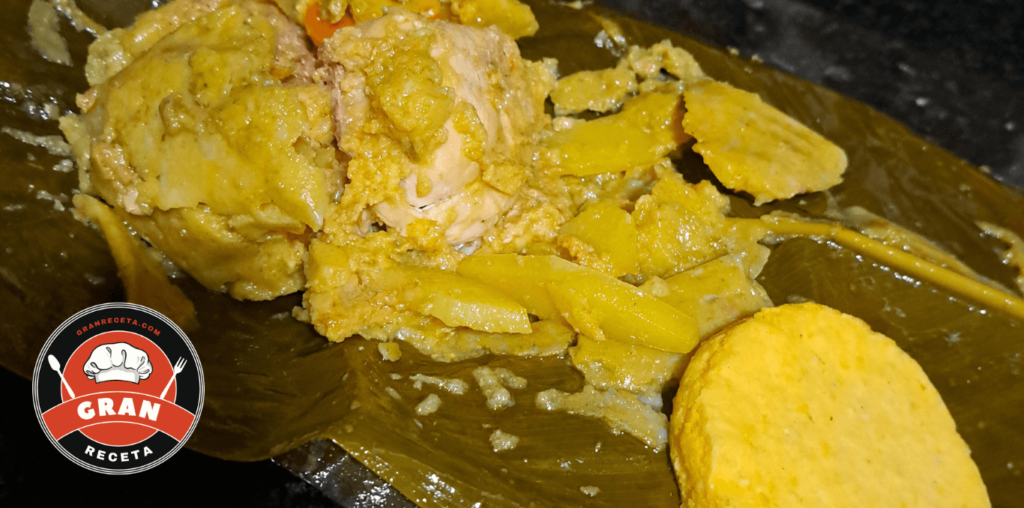
Make chicken tamales the way you’d make pork ones and they come out bland — that’s the trap, and it surprised me the first time too. Chicken broth is lighter and more neutral than pork, so a chicken tamale leans on its sofrito far more than a pork one does. Get that one thing right (a sofrito cooked dark and worked into the masa, not just the filling) and Colombian chicken tamales are the lighter, leaner member of the tamale family, with the same banana-leaf wrap and 2-hour steam as the rest.
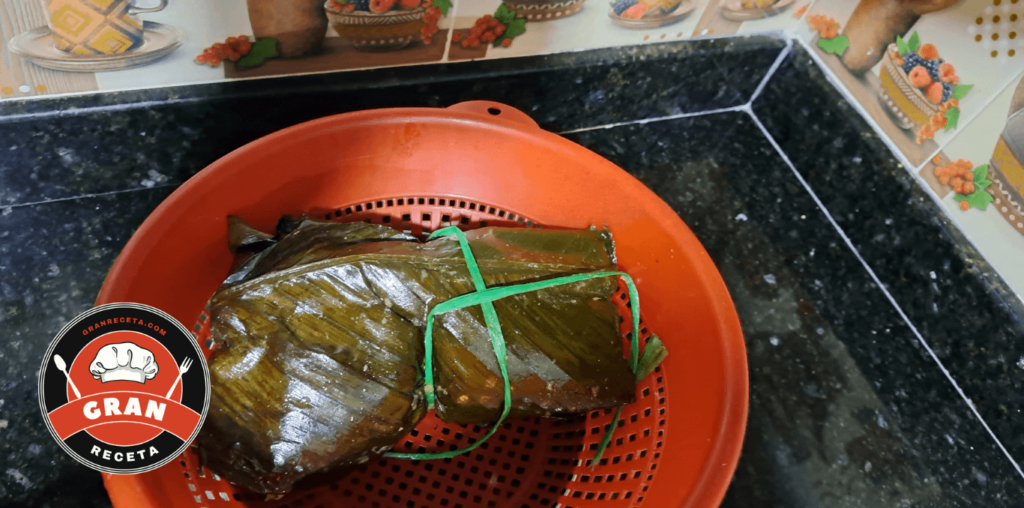
How do you make Colombian chicken tamales? Marinate thighs and legs with garlic, onion, and spices 2 hours. Cook 35-40 minutes and save the broth. Make a deep sofrito of onion, bell pepper, and tomato for 20 minutes. Make corn masa with the broth and 3/4 of the sofrito. Assemble with chicken, potato, carrot, and peas in banana leaf. Tie and steam 2 hours. Makes 12 tamales, about 210 minutes total.
What a Colombian tamale is, and where chicken fits
A Colombian tamale is corn masa and a savory filling wrapped in banana leaf and steamed about 2 hours — a relative of the Mexican tamale, but bigger, leaf-wrapped instead of husk-wrapped, and eaten as a full meal. Colombia has many regional kinds: the rice-and-pork tamal tolimense, the huge tamal valluno with whole chicken pieces, the simple pork tamale. The chicken version is the lightest of the everyday ones, about 380 calories each against 445 for pork, but it’s also the one that most needs technique, because chicken brings less of its own flavor to the masa.
A couple of ingredient notes for a kitchen outside Latin America. Masarepa is precooked corn flour, the same one used for arepas, sold at Latin groceries and many large supermarkets, and it skips any corn-soaking. Banana leaves come fresh or frozen from Latin and Asian groceries; foil will hold a tamale together but adds none of the leaf’s aroma.
Why thighs and legs, never breast
This is the most documented mistake in home chicken tamales: reaching for breast because it’s “healthier.”
Breast in a tamale (2 hours of steam): after 2 hours the breast comes out completely dry, shredded into flavorless threads, and it makes a broth with almost no collagen or fat, giving a bland masa. Thighs and legs (2 hours of steam): the connective tissue in the thigh turns to gelatin over the 2 hours and keeps the meat moist. The chicken stays tender with presence in every bite, and the broth has real body.
If breast is all you have, marinate it heavily, add 1 extra tablespoon of oil to the masa, and cut the total cook to 1 hour 30 minutes, since less time means less moisture lost.
The sofrito does the heavy lifting
Chicken and pork tamales share the same base process, but two steps change for chicken, and both come down to the sofrito.
The broth. Chicken broth is clearer, leaner, and more neutral than pork, with less collagen and less fat, so masa made with it has less natural flavor to start from.
The sofrito. To make up for that, the chicken tamale’s sofrito needs a longer cook on the tomato. At 15 minutes the tomato loses its acidity and concentrates its natural sweetness, and that concentrated flavor is what gives the masa depth. A 5-minute sofrito leaves a raw acidity that fights the mild chicken instead of supporting it.
And the step most recipes skip: work part of the sofrito into the masa itself, not just the filling. Sofrito only in the filling gives a masa of uniform color and neutral taste: the filling has flavor but the masa around it doesn’t. Sofrito in masa plus filling means every bite of masa carries the flavor. The proportion that works best is 3/4 of the sofrito into the masa, 1/4 reserved for the filling.
Fitting it to your kitchen
- If it’s your first time making tamales — chicken is friendlier than pork: it cooks faster and the masarepa masa is easy to handle
- If breast is all you have — use it, but cut the cook to 1 hour 30 minutes and add 1 extra tablespoon of oil to the masa
- If you can’t find banana leaves — foil holds the tamale; you lose the smoky aroma of the leaf but the technique is the same
- If you want it lighter — skip the oil in the masa and use degreased broth; the tamales come out drier but leaner
- If you’re cooking for 24 — double it; the cook time doesn’t change, just use a big enough pot
What ruins chicken tamales
Breast instead of thighs. After 2 hours of steam the breast is dry and flavorless. Bone-in thighs and legs are the only correct choice.
A 5-8 minute sofrito. Chicken broth is neutral and needs a well-concentrated sofrito. A 5-minute tomato keeps a prominent acidity that doesn’t balance the mild chicken. Give it the full 15 minutes.
Not working sofrito into the masa. Masa with no sofrito is bland masa that contrasts with the filling instead of complementing it.
Uncovering before 60 minutes. Losing steam in the first 60 minutes gives tamales with raw masa in the center. Cover tightly and leave it shut.
What to serve it with
The classic pairing is hot chocolate — tamale with hot chocolate and an arepa is the weekend breakfast across Colombia, and a 380-calorie tamale makes that a full plate. Aguapanela with lime is the regional alternative. For a celebration spread, chicken tamales sit beside pork tamales so each person can choose, and the lighter chicken pairs naturally with a bowl of ajiaco, the Bogotá chicken-and-potato soup.
Frequently asked questions
Can I use rotisserie chicken to save time? You can for the meat, but you’ll lose the spiced broth that flavors the masa, so use chicken stock with a little of the marinade simmered in. The broth is the part that carries the dish.
Why is my masa bland even though the filling tastes good? Because the sofrito went only in the filling. Work 3/4 of it into the masa; that’s the single change that fixes a flat chicken tamale.
Can I make them ahead or freeze them? Yes. Cooked tamales keep 3-4 days in the fridge in their leaf and freeze up to 3 months. Reheat by steaming 15-20 minutes, or microwave in the leaf.
Are these spicy? No, Colombian tamales aren’t chili-hot. The achiote is for color and mild earthiness. Serve ají on the side if you want heat.
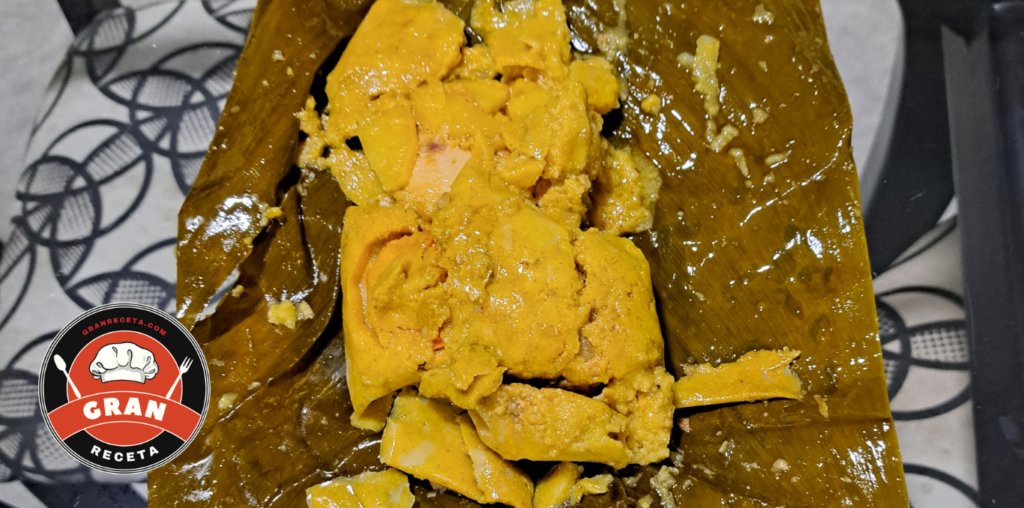
Chicken tamales were the first variation I made after learning the pork ones, expecting them to be simpler, being the lighter meat. The first batch was a letdown: bland masa and dry meat. The lesson was that chicken needs more work in the sofrito, not less. The milder meat calls for the more intense sauce. — Josnaisis.